Showing posts with label semikonduktor. Show all posts

Jan 4, 2012

Harga USB Sandisk Cruzer Flash Disk


Berapakah harga USB Cruzer 16GB di akhir tahun 2011 ? Fitur standar, dilengkapi enkripsi data, dengan kualitas yg tak bikin pusing. Dengan melakukan survey 30 menit di Simlim Square bulan lalu didapat variasi harga antara S$20 - S$31 (mestinya kurang dari Rp. 200 ribuan). Harga termahal diperoleh di kaunter-kaunter lantai dasar, toko-toko besar di tiap lantai, lalu menurun mengikuti besar toko dan tinggi lantai. Artinya semakin tinggi lokasi toko dan semakin kecil toko tsb maka harganya paling murah.

Apa benar paling murah ?
Seminggu setelah membelinya, memang "terasa" paling murah, karena saya dapat dengan harga S$21. Apalagi jika dibandingkan dengan USB flash disk pertama kami yg sudah berusia 8 tahunan (masih tipe 1.0 dengan isi perut hanya 128 MB), dibeli di Munich seharga EUR39. Namun pada hari pertama masuk kantor tahun 2012, teman saya pun tnyt baru membeli USB Cruzer 16GB hanya beda penampilan (kalau tak salah Fit tipenya), dengan harga S$16. Harga promo tahun baru di Giant Hypermart katanya. Yah kebanggaan semu yg hanya bertahan seminggu ... Namun dlm seminggu sudah banyak manfaat yg diperoleh saat Cruzer test bareng Regza :-)

USB 2.0 flash disk sudah bukan teknologi baru apalagi untuk kapasitas kurang dari 32GB. Banyak dibuat di China dengan dua tiga merek saja yg populer di sini: Sandisk, Imation, dan Toshiba. Khusus Cruzer, benar-benar milik sejuta umat, ia dipajang di semua toko ! Toko-toko di Simlim markup harga Cruzer dua hingga tiga kali lipat dari modal, sementara Giant cuci gudang cukup banting harga dgn profit margin 33% plus pajak :-)

Nantikan USB 3.0 flash disk di tahun 2012.

Catatan:
Asumsi saya harga jual Cruzer dari distributor adalah $10. Ditawarkan di Simlim antara $20-30 (markup 2-3x) dan harga promosi di Giant dengan profit margin 33% ($10/(1-1/3)  = $15) plus 7% pajak.

...
ringan di awal tahun
...


Dec 31, 2011

Harga TV tak pernah Inflasi

Dua belas tahun lalu harga sebuah Toshiba Boomba 25", TV tabung/CRT kelas menengah berlayar datar dengan berbagai fitur, sekitar 3 jutaan rupiah. Hari ini satu unit LCD TV berukuran layar 25% lebih besar sudah dapat dibawa pulang dengan harga 25% lebih murah dibandingkan Boomba 25" yg bulky itu. Tiga tahun lalu LCD TV termurah sekitar Rp. 6 jutaan krn masih asli made-in-jepun atau korea, namun saat ini utk model-model pemula (entry level) sudah dapat dibuat dengan kualitas baik di Indonesia, Vietnam, Taiwan dan Cina, sehingga harga per unit langsung menjunam sepertiga nya !

Harga LCD TV "terbanting" disebabkan dua alasan utama: pertama, teknologinya sudah matang sehingga dapat dirakit di negara lain yg lebih murah SDM dan kedua, hadirnya produk layar tipis baru LED TV. Lebih tipis sekitar satu inchi saja dan lebih hemat daya. Harga LED TV hanya terpaut S$150 - 200 (more!) untuk kelas yg sama. Harga premium masih menempel pada layar tipis (Plasma/LED) yg memiliki fitur "masa depan" seperti Internet (SmartTV) dan 3D karena teknologinya masih diproteksi negara prinsipal aslinya (Korea, Jepun). Namun hingga akhir 2011, mayoritas konsumen masih tak memerlukan fitur futuristik tsb.

Sebuah keluarga yg tiga tahun lalu "perlu menabung" S$1 per hari (Rp. 6000 selama 3 tahun) untuk membeli LCD TV, kini sudah dapat melakukannya hanya dalam setahun. Spt catatan yg saya buat di FB akhir 2009 bahwa TV adalah media/sarana hiburan termurah yg dapat dinikmati keluarga. Sang penakluk berupa kotak berkaca hitam ! Anda cukup puasa minum kopi di kedai kopi selama 365 hari, Anda bakal punya LCD TV yg sangat mudah digunakan oleh siapa saja ini (Catatan: harga kopi susu naik tajam 20-30 cent atau Rp. 1500 dalam 10 tahun ini, sementara harga TV malah terjun bebas).

Regza 32PS10 model 2011 berdiameter layar 32", tebal panel 3 inchi, berat kurang dari 10 kg, dan makan listrik rata-rata 63 W. Kami amati pertama kali di showroom Mustafa dan langsung cocok dgn kualitas gambar, fitur, dan tentu harga (S$389). Hari itu (24/12) pelayan menerangkan tiga model yg sekelas yaitu buatan Samsung, Panasonic, dan Toshiba, beda harga S$10-15. Keunggulan Regza 32PS10 ini krn punya  dua port HDMI, dapat memainkan langsung dari USB flash disk 27 format video, dan gratis satu kabel HDMI :-) Lebih bangga lagi krn ternyata ia pun buatan Indonesia seperti si Boomba. Setelah sekitar 1.5 tahun puasa TV, kini muncul lagi TV di rumah, meski menyalanya rata-rata kurang dari 4 jam sehari saja. Istri yg ikut survei heran juga lhoo ... bukannya memilih model Samsung yg saat ini rajanya TV LCD-LED he..he..

Pasaran LCD-LED-TV dunia (sumber)
Persaingan dan kejatuhan harga TV layar tipis memang gila, apalagi pemain Taiwan (khusus layar LCD ukuran 42" ke bawah) sudah bermunculan. Khusus 2011 masalah berat lain "tak seolah tak relevan" bertambah: mulai dari gempa di Jepang, PIIGS di EU terancam bangkrut, kredit macet di US, inflasi yg tak berhenti naik, membuat konsumen menunda keinginan utk ganti TV atau beli TV yg lebih besar dengan fitur-fitur baru. Tak heran para pemain besar pun telah lama  bergandengan tangan (strategic alliance), misalnya Samsung+Sony, Samsung+Vizio (khusus US), dan LG+Philips. Di penutup 2011, secara global Samsung dan LG menempati dua posisi teratas pangsa pasar dan disusul oleh Sony dan Toshiba (lihat tabel).

Sayangnya tradisi nama besar dan promosi yg heboh tak selalu berarti kesuksesan. Kenyataan pahit dirasakan oleh Sony "si juara tiga" yg mengalami kerugian di pasar TV empat tahun berturut-turut. Akhir minggu lalu Sony telah mengumumkan akan menjual seluruh saham nya di joint venture S-LCD yg dibentuk tahun 2004 bersama Samsung. Sepertinya layar tipis andalan SONY yaitu Bravia tinggal menghitung bulan-bulan terakhir saja untuk bertengger di rangking tiga atau bahkan menutup sama sekali bisnis ini.

Persaingan memang sengit, sulit bertahan jika produsen tidak mampu meraih posisi 1 atau 2 di kelasnya. Harga terus ditekan dan margin keuntungan semakin kecil. Lebih beruntung menjadi pebisnis kuliner yg dapat menaikkan harga daganganya 10-20% tiap tahun :-)

Selamat tahun baru 2012 !

Sep 10, 2009

ATIC bought CHRT

1. Abu Dhabi firm offers to buy Singapore's Chartered Semiconductor

Posted: 07 September 2009 1233 hrs

SINGAPORE: An Abu Dhabi investment firm has offered to buy Singapore's Chartered Semiconductor for US$3.9 billion, which would create one of the world's largest microchip makers, officials said on Monday.

The buyout by Advanced Technology Investment Company (ATIC) comes as chip companies around the world look to boost sales after being hit hard by falling demand brought about by the global slump.

Chartered chairman James Norling said the firm had been looking at several "potential strategic options" and the offer from ATIC was the best. "After carefully looking at all of these strategic options in front of us, we believe this proposal is definitely worthy for the company shareholders to consider," he said at a news briefing.

ATIC, Abu Dhabi's investment vehicle in the high-tech sector, is also the main shareholder in Globalfoundries, a joint venture with US firm Advanced Micro Devices (AMD), focused on making next-generation chips.

Chartered is the world's third biggest maker of custom-made chips, but it has been struggling to catch up with leaders Taiwan Semiconductor Manufacturing Company (TSMC) and United Microelectronics Corp (UMC), also of Taiwan. It has also been hit by the global economic crisis, but the industry is banking on rising demand for "billions of new mobile phones, cars, televisions, computers and other devices" that are run by chips, the firms said in a joint statement.

ATIC chief executive Ibrahim Ajami said the combined strengths of Chartered and Globalfoundries would make them number two in the world, behind market leader TSMC in terms of capacity. "Right now Chartered is ranked, from the microchip perspective, as the third leading foundry in the world. A combination with Globalfoundries would put us as the second leading foundry in the world," he said.

ATIC, which is owned by the Abu Dhabi government, wants to buy each Chartered ordinary share at S$2.68 in cash, valuing the company at about US$1.8 billion. Including Chartered's debt and convertible redeemable preference shares totalling US$2.2 billion, the transaction will have a total value of about US$3.9 billion, the two companies said in a joint statement. ATIC's offer per share for Chartered represents a premium of 14.2 per cent on its 30-trading day volume weighted average price, the statement said.

Singapore's Temasek Holdings, which owns about 62 per cent of Chartered, has thrown its support behind the deal, said Norling. He added that Morgan Stanley and Citigroup Global Markets have been hired as financial advisers to the Chartered board of directors while Deutsche Bank has been called in to advise shareholders, who must approve the move. The offer will also have to be sanctioned by the Singapore High Court. If it all goes ahead, the transaction could be sealed by the end of the year, Norling said.

Chartered chief executive Chia Song Hwee said the company would not solicit competitive bids, but would have to go through the process if there were unsolicited offers. "All parties concerned are very committed to make this scheme go through," Chia said at the news briefing.

ATIC chairman Waleed Al Mokarrab Al Muhairi said he believes Temasek's support for the deal will discourage any other interested parties. "We believe that we are the best choice for Chartered's current investors. We believe we have a compelling offer on the table," he said.

Ajami said if the deal goes through, both Chartered and Globalfoundries will have different management teams. However, he would not rule out merging the two in the future.

Globalfoundries chief executive Douglas Grose told AFP in an interview in April that the company will spend US$3.3 billion to build a manufacturing plant in New York's Saratoga County, which will be fully operational by 2012. Another US$2.7 billion will be invested to upgrade its operations in the German city of Dresden and boost overall processes as well as sales, marketing and design activities.

- AFP/yb/ir


2. Temasek Holdings to sell 62% stake in Chartered Semiconductor Manufacturing to Advanced Technology Investment Company

Sep 10, 2009 (Datamonitor Financial Deals Tracker via COMTEX) -- CHRT --

Singapore-based investment company Temasek Holdings (Private) Limited has agreed to sell its approximately 62% stake in Chartered Semiconductor Manufacturing, Ltd. to Advanced Technology Investment Company (ATIC).
ATIC is a technology investment company wholly-owned by the government of Abu Dhabi in the UAE, while Chartered is a Singapore-based semiconductor foundry that provides wafer fabrication services and technologies to semiconductor suppliers and systems companies.

Under the scheme of arrangement, each Chartered ordinary share will be acquired by ATIC for a cash consideration of SGD2.68 ($1.86) per share. The transaction represents an equity value of approximately SGD2,500 million ($1,739.48 million) and a total value of approximately SGD5,600 million ($3,896.44 million), including debt and convertible redeemable preference shares of approximately SGD3,100 million ($2,156.96 million) as of June 30, 2009.

The price represents a premium of 14.2% to its 30 trading-day volume weighted average price, 26.8% to its 90 trading-day volume weighted average price, and 44.2% to its 6-month volume weighted average price.

The acquisition of Chartered will be made through ATIC International Investment Company LLC, a subsidiary of ATIC. Once the transaction is completed, ATIC will be the sole owner of Chartered.

Earlier on May 29, 2009, according to Reuters, The Business Times reported that ATIC has made an offer to acquire a 60% stake in Chartered from Temasek Holdings. On the same day Chartered has denied of receiving such a bid from ATIC.

Morgan Stanley Asia (Singapore) Securities Pte., Ltd. and Citigroup Global Markets Singapore Pte., Ltd. are acting as joint financial advisors to Chartered, and each providing a fairness opinion to the board of directors of Chartered in connection with the transaction. Deutsche Bank AG is acting as an independent financial advisor to advise shareholders on the fairness of the offer.

Deal Value (US$ Million) 2415.79
Deal Type Private Equity
Sub-Category Exit
Deal Status Announced: 2009-09-07
Deal Participants

Target (Company) Chartered Semiconductor Manufacturing Ltd.
Deal Rationale

The transaction would allow ATIC to build on the complementary platforms of Chartered and GLOBALFOUNDRIES, with Chartered's customer relationships and capabilities in both 8-inch and 12-inch fabrication, and GLOBALFOUNDRIES' technology expertise, capacity profile and global footprint. By acquiring Chartered, ATIC is expanding its investments in the semiconductor industry which currently consist of a GLOBALFOUNDRIES facility in Dresden, Germany.

Jan 21, 2009

Fujitsu Lifebook E8420P

17 januari 2009 menjadi hari yang cukup bersejarah dalam lembaran teknologi informasi kami. Setelah menikmati 2360 hari kebersamaan atau hampir enam setengah tahun bersama NEC Versa akhirnya dapat notebook baru.

Edisi terbaru dari Fujitsu seri E yaitu E8420P. Cutting edge highlights:
  • Centrino Core Duo T9400 (2.53GHz, 6MB L2 cache, 1066MHz FSB)
  • 4 GB DDR3 1066MHz
  • 320GB HDD (SATA-150 5400rpm, S.M.A.R.T support, Two Partitions C, D, with Fujitsu shock sensor)
  • 15.4-inch SuperFine WXGA TFT 1280 x 800 pixels
  • NVIDIA GeForce 9300M
Alhamdulillaah sesuai dengan impian notebook selama ini. Pertimbangan memakai Fujitsu karena memang tak banyak pilihan untuk notebook 15.4" selain HP, Vaio, dan Dell (non-Taiwan brand). Kualitas HP dan Vaio memang baik namun agak di luar bajet 2009. Selain itu HP dan Dell membawa bendera Amerika yang selalu kami hindari selama ada alternatif yang sama atau lebih baik.

Modelnya sederhana tanpa banyak kerlap-kerlip LED di sana-sini. Memakai Vista Business dengan mesin ini amat mulus dan tampilan layarnya halus. Diklaim masih orisinil buatan Jepun, insya Allah bermanfaat dan tahan lama di atas umur teknisnya ... seperti saudara tuanya si NEC :-)

Sep 2, 2008

Maju Kena Mundur Kena di 2 GHz

Dari COMEX 2008 Singapura 28-31 Agustus 2008 lalu, pasaran notebook dengan prosesor Intel di bawah 2 GHz terus terjepit. Tekanan dari atas adalah "hukum rimba teknologi" dengan hadirnya model-model notebook baru dengan spesifikasi prosesor Centrino Core 2 Duo dengan frekuensi minimum 2 GHz dalam 4 bulan terakhir ini dan desakan sub-notebook sekelas Asus-Eee atau UMPC (ultra mobile PC) dari arus bawah. Prosesor Intel di bawah 2 GHz untuk notebook terdiri dari dua keluarga yaitu Pentium dual-core generasi pertama atau Core Duo (contohnya T2370 1.73 GHz dan T2390 1.86 GHz) dan Centrino Core 2 Duo (misalnya T5550 1.83 GHz dan T5750 2 GHz) yang lebih hemat daya, lebih cepat (667 MHz FSB dibandingkan 533 MHz), dan lebih besar L2 cache nya (2 MB L2 dibandingkan 1 MB). Catatan: Core 2 Duo adalah generasi kedua Core Duo, yang dapat mendukung kinerja hingga 1066 MHz FSB dan "lebih kaya" L2 cache hingga 6 MB.

Untuk dua model pertama T2370 atau T2390, sebuah notebook pemula dengan konfigurasi standar 14.1" LCD, 2 GB DRAM, 160 GB HDD, dan kartu grafik on-board (biasanya chipset Intel 965GM) sudah dibanting dengan harga rakyat antara SGD 800 - 900 (OS: Windows Vista Home Basic). Sementara Core 2 Duo 2 GHz juga sudah dapat dibawa pulang dengan selembar uang 1000 an saja (SGD), meskipun hanya dalam jumlah terbatas tiap hari. Jangan salah harga-harga tsb untuk merek-merek notebook terkenal seperti Compaq, Toshiba, NEC, dan Acer, trend cuci gudang nih. Persaingan sengit di kelas ini juga diikuti merek-merek lain semacam LG, Asus, dan Axioo (lupa saya cermati brosurnya).


Notebook di bawah 2 GHz secara perlahan digantikan dengan hadirnya sub-notebook semacam Eee PC (Asus) atau mini-note (HP). Diotaki prosesor Intel Celeron-M 900 MHz, VIA atau yang terbaru dari Intel ATOM N270 1.6 GHz prosesor, sub-notebook merupakan solusi cepat dan murah bagi pemakai komputer baru atau orang-orang yang tak membutuhkan notebook sebagai pengganti desktop PC. Target pasarnya jelas: pelajar sekolah (e-Learn, e-Play, webmail), ibu rumah tangga (chatting, social networking (SNS), blogger), agen properti/asuransi, salesman, project manager, online broker/gambler, dan si tukang IT yang perlu bergerak 24x7x365 adalah beberapa individu yang paling mendambakan produk semacam ini. Mesin pintar ini yang pasti ringan dijinjing (1 kg+), mudah digenggam (tipis dan diameter LCD hanya 7" - 9"), lebih murah (SGD 500 - 900), lebih hemat daya (sehingga batere lebih tahan lama di luar rumah), startup lebih cepat (hindari Vista tentunya), dan mudah digunakan karena mesin ini datang dengan berbagai program yang benar-benar dibutuhkan para pemakai yang tak mau repot tadi (internet, pemain mp3/mpeg, pembaca email, open office, acrobat reader, YM/Skype, games dll). Kinerja prosesor 1 GHz, 1 GB DRAM, dan penyimpan 40 GB SSD (solid state disk) tetap terasa nyaman saat digunakan untuk apikasi/program umum tadi, sehingga tidak ada perlunya berkeringat membayar USD 2000 untuk kebutuhan yang sama.

Jadi saya sarankan untuk sesiapa saja yang hanya membutuhkan notebook untuk keperluan asasi atau standar tidak perlu mengeruk saku lebih dalam mulai hari ini. Pilihan akan berlaku ekstrim, semurah-murahnya (Rp. 5 juta-an) atau mahal sekalian (di atas Rp. 20 juta). Bila memang masih mengidamkan punya notebook "yang sedang-sedang saja" karena tradisi, pertimbangan estetika atau kesehatan mata, maka cukup membeli notebook dibawah harga Rp. 10 juta karena kinerjanya sudah baik. Kalau perlu belinya ditunda akhir tahun saja karena notebook 2 GHz sudah pasti bakal tergusur ke harga 5 jutaan. Namun jangan sampai lengah, karena menunggu terlalu lama, prosesor 2 GHz ini pun sudah tak bakal dijual lagi di rantau ini (ini taktik dagang). Di ekstrim lain, bila Anda membutuhkan sebuah notebook pekerja keras untuk 3D games, menonton HDTV video on demand, atau aplikasi grafis/visual yang intensif lainnya maka tunggu Core 2 Duo T9400 dengan 1066 MHz FSB dan 1066 MHz DDR3 RAM ramai di pasaran :-)

Gambar diambil dari NEA Juli 2008.


Aug 13, 2008

9 dari 10 notebook di dunia dibuat di Taiwan

Tomohiro Otsuki dalam Nikkei Elektronics Asia bulan Juli 2008 menulis 90% desain dan rakitan notebook atau laptop dunia dikuasai industri-industri Taiwan. Ditampilkan dalam bentuk matriks dimana 9 pemilik merek besar notebook dunia mempercayakan perakitan produk mereka pada 10 produsen Taiwan. Sisanya sekitar 10-15% pasar perakitan notebook masih dilakukan di dalam negeri Jepang untuk model-model tertentu keluaran NEC, Toshiba, dan Sony. Sementara itu EETimes Asia mencatat sekurangnya ada 15 industri desain dan manufaktur (ODM) perakit notebook untuk seluruh dunia.

Quanta (31% pasar), Compal (24%), Wistron (16%) dan Inventec (11%) adalah empat pemain besar ODM Taiwan. Acer dan Asustek adalah merek lokal Taiwan yang pada awal berdirinya dianggap sebagai komputer tak bermerek (no-brand). Namun kini Acer menempati peringkat tiga (setelah HP dan Dell) dan Asustek pula pada peringkat delapan dari pasaran notebook dunia yang mencatat pengiriman 137 juta unit per tahun pada tahun 2007. Bayangkan dengan pemain lokal di negeri kita yang hanya satu dua seperti Zyxel dan Axioo.

Trend 2008 ke depan diantaranya:
  • Merebaknya segmen baru notebook kelas ringan dibawah USD 500 meniru produk perdana Asus eeePC (hemat daya, ringan, dan kecil). Everex dan HP telah mengeluarkan produk yang sama. Langkah ini ditanggapi serius dengan melihat prospek prosesor baru untuk mendukung segmen ini seperti Intel Atom dan VIA (sistem x86) dan ARM yang populer di pasaran embedded peripherals.
  • Penyimpan data berbasis semikonduktor (solid state drive) yang semakin kompak. Terakhir kapasitasnya sudah mengejar 40GB. Meskipun kapasitas lebih kecil, SSD lebih unggul dibanding HDD dalam hal hemat daya, akses data lebih cepat, dan realibilitas karena tidak adanya bagian yang bergerak.
  • Pencahayaan monitor notebook yang menggunakan dioda pemancar cahaya (LED backlights). Ini akan menghemat konsumsi daya 10% dibanding cara konvensional saat ini dan dapat menghasilkan monitor yang lebih tipis dan ringan.
Sumber
Laporan Computex 2008
EETimes Asia
Analisis oleh Tomohiro Otsuki dalam NEA


Jun 26, 2008

Menanti notebook dengan DDR3 DRAM

Mengikuti trend penutup tahun lalu, dua kuartal pertama tahun 2008 ini mencatat harga memori (DRAM) untuk kebutuhan PC dan notebook cenderung tetap pada level terendah dan belum ada tanda-tanda kenaikan. Setiap perusahaan penghasil DRAM banting harga dan ini menguntungkan konsumen. Mayoritas modul DRAM yang terpasang pada PC atau notebook baru saat ini berasal dari keluarga chip DDR2 dengan frekuensi operasi maksimum dari 533 hingga 1066 MHz (PC4200 - PC8500). Khusus untuk notebook gres di pasaran baru dilengkapi DDR2 667 atau paling keren 800 MHz.

Mengapa produsen notebook belum mempromosikan pemakaian DDR3 dalam produksi baru mereka, sementara memori generasi ketiga ini telah eksis lebih dari 1 tahun di pasaran ?
  1. Faktor ekonomi mungkin menjadi alasan utama: inflasi tinggi, dollar AS yang melemah, harga minyak dunia melangit, inventori lama yang belum habis karena daya beli masyarakat menurun dll.
  2. DDR3 lahir sebelum waktunya (DDR3 was too far ahead of it's time to be adopted early on -- komentar Olin Coles,Mai 2008). Untuk memanfaatkan kecepatan maksimum dari DDR3 tentu dibutuhkan kelas papan induk (motherboard) yang mendukung kecepatan bus (FSB) minimal 800 MHz. Ini menyebabkan harga produk akhir menjadi tinggi dan hanya "dianggap wajar" oleh para gamer serius pemakai Alienware Area-51 atau penggemar overclocker sejati saja. Mayoritas pemakai umum untuk bekerja di rumah atau kantor belum membutuhkan kinerja ini.
  3. Harga masih tinggi. Sebagai perbandingan harga modul DDR3 notebook merek Crucial dengan specs DDR3-1066/PC3-8500 dijual dengan harga USD 85 (1GB) dan USD 145 (2GB), sementara DDR2-800/PC2-6400 dilepas dengan harga jauh lebih murah yaitu USD 26 (1GB) dan USD 55 (2GB). Di Singapura sendiri harga untuk Kingston DDR2-667 berkisar antara SGD 32-35 (1GB) dan SGD 62 - 65 (2GB). Sementara untuk versi 800 MHz hanya lebih mahal sekitar SGD 5 - 10 saja per GB. Namun fenomena ini relatif mengikuti hukum pasar saja, menunggu sampai DDR3 menjadi komoditas semacam DDR2.
  4. DDR3 akan terasa lebih efektif jika disandingkan dengan CPU dan sistem operasi 64 bit. Pangsa pasar 64 bit saat ini ada dua diantaranya: (1) high-end server untuk aplikasi dan penyimpanan (2) piranti network kakap semacam application gateway, core/distribution router, dan datacenter-class switch.
HP dengan notebook gaban HDX series yang memakai Intel Core 2 Extreme X9000 (2.8 GHz) belum merasa perlu untuk menggunakan DDR3. Demikian pula dengan notebook mahal Fujitsu Lifebook E8410 yang hanya menyandingkan DDR2-667 dengan Intel Core 2 Duo T9300 (2.5 GHz). Memang mempopulerkan DDR3 pada notebook membutuhkan waktu lebih lama karena belum tersedianya chipset yang optimal untuk mendukungnya.


Tiga Keunggulan DDR3
3. Hemat energi
Dengan energi yang lebih hemat maka disipasi panas ke lingkungan akan berkurang sehingga kebutuhan pendingin udara pun berkurang. Ini amat dirasakan di ruang-ruang server semacam datacenter (server-server aplikasi web/email/ERP/database skala menengah hingga tinggi) ataupun network operation control (NOC) yang disesaki server, router, switch, firewall, IDS dll. Sebagai contoh satu server berbasis Intel Xeon Quad 64bit membutuhkan daya tak kurang dari 500W pada operasi normal, bayangkan panas yang terbuang ke ruangan kalau ada 100 server macam itu bekerja bersama. Panas yang dilepas itu tentunya harus dikompensasi dengan pengaliran udara dan pendinginan (HVAC) yang tepat. Semuanya membutuhkan energi, yang jelas akan berdampak pada naik turunnya tagihan listrik di akhir bulan nanti.

2. Umur batere lebih lama
DDR3 yang dicatu tegangan 1.5V adalah 17-30% lebih hemat pada operasi normal dibandingkan DDR2 yang dicatu 1.8V. Contoh lebih ekstrim jika membandingkan DDR2-1066 yang dicatu tegangan lebih tinggi lagi yaitu 2.2V, akan diperoleh 32% penghematan dibandingkan DDR3-1600. Ini adalah keuntungan yang sama dirasakan pada saat konsumen bertukar dari DDR ke DDR2 lima tahun yang lalu, dimana catu tegangan turun dari 2.5 V (DDR) ke 1.8 V. Penghematan energi yang terpakai akan memperpanjang daya tahan batere selama notebook dipakai mobile (menurut Samsung umur batere akan lebih lama 20 menitan dibanding DDR2).

1. Kinerja Dobel
Dengan kemampuan transfer data dua kali lebih banyak (8 bit prefetch architecture) dibandingkan DDR2 (4 bit prefetch architecture) tentunya menghasilkan kinerja yang meningkat minimal dua kali lipat. Sistem yang dikombinasikan dengan tepat antara CPU (external clock speed, ukuran L2 cache, dan dual-channel memory access), chipset (kecepatan FSB speed), dan DRAM (kecepatan max system) akan menghasilkan peningkatan kinerja yang istimewa. Utilitas CPU-Z mudah dipakai untuk mengidentifikasi spesifikasi notebook yang Anda pakai saat ini. Sebagai contoh "versi pemula" dari PC Alienware Area-51 di atas dibangun oleh Intel Core 2 "Penryn" dengan 6 MB L2-cache (Duo), 1333 MHz FSB, dan 4 GB DDR3-1333.

Penghasil DDR3
Manufaktur modul DRAM terkenal untuk desktop PC (soket 240 pin DIMM) dan notebook (soket 200 pin SO-DIMM) yang dibandingkan adalah Kingston, OCZ, Corsair, dan Crucial (info lengkap baca di Toms Hardware). Produksi chip DDR3 saat ini dikuasai oleh pemain-pemain besar seperti Samsung, Hynix, Qimonda, dan Micron. Diperkirakan pasar komputer dengan DDR3 baru akan ramai pada pertengahan tahun 2009 sementara untuk notebook akan datang lebih lambat lagi. Intel hadir dengan chipset Bearlake-X sementara AMD hadir dengan soket AM3 untuk mendukung DDR3 (awal 2008) sesuai tulisan di EETimes pertengahan tahun lalu.

Mengenal label DDR3
Sebagai informasi, keluarga DDR DRAM memiliki kode yang diatur oleh JEDEC standard dengan simbol penamaan DDRn-xxxx/PCn-yyyy. Kode dibaca sbb.: n adalah generasi DDR chip 1/2/3, xxxx adalah frekuensi operasi maksimum tiap chip yang terpasang dalam keping DRAM, dan yyyy adalah kode untuk keping modul DRAM secara kesatuan yang menyatakan kecepatan transfer maksimum data dalam satuan megabyte/detik (MB/s). Sebagai contoh sekeping modul memori untuk notebook (SO-DIMM) dengan label DDR2-667/PC2-5400 akan memiliki spesifikasi sbb :
  • Merupakan generasi kedua dari DDR
  • Dapat dipaksa bekerja hingga frekuensi maksimum 667 MHz (kecepatan clock internal nya hanya 50% dari frekuensi maksimum ini yaitu 333 MHz).
  • Angka 5400 menunjukkan kecepatan transfer data dalam megabyte per detik, dalam contoh ini DDR2-667 dapat melakukan 5336 MB/s (dan dibulatkan 5400)*.
Jadi bagaimana kesimpulannya, apa perlu bersabar menunggu notebook kelas rakyat dilengkapi DDR3 ? Apa kinerja DDR3 benar-benar dibutuhkan mengingat harga premium yang dibayarkan dan keperluan notebook hanya untuk pemakaian di rumah sahaja: surfing di internet, pengolah kata, nge-blog, presentasi, mendengarkan MP3, menonton DVD/Youtube, chatting, ... Mau nunggu upgrade sampai kapan ! :-)

Catatan:
*The maximum transfer rate for a memory module can be calculated thru the following formula:
DIMM modules transfer 64 bits or 8 bytes at a time, we can simplify this formula to:
Maximum Theoretical Transfer Rate = clock x 8

Grafik berasal dari halaman Samsung DDR3

Jun 15, 2008

Mencari notebook pemula

Awal Agustus nanti tepat enam tahun masa bakti notebook NEC Versa Premium kami (PIII 1.2 GHz, 384 MB DRAM, 20GB HDD, 15.1" SVGA, WinXP Home SP2). Alhamdulillaah sudah melampaui umur teknis barang elektronika rumahan yang rata-rata 5 tahun tanpa memberi kenangan kesulitan yang berarti. Kalau dicari kekurangannya saat ini mungkin agak lambat untuk buka banyak aplikasi, suara fan yang ribut, belum dilengkapi akses nirkabel (wireless), masih USB 2.0 dan batere nya sudah tak dapat dipakai lagi sejak 3 tahun yang lalu. Ingin hati cari pengganti si notebook abu-abu ini mengingat harga yang kompetitif saat ini karena banyak pilihan, perbaikan kinerja, dan lebih hemat energi.

Yang jadi incaran entry-level notebook (buat pemula) dengan spesifikasi minimum: Intel Centrino Core-Duo, layar XGA 15 inch ke atas, memori DDR2 minimal 2 GB, HDD minimal 100 GB, penulis CD/DVD, dan perlengkapan standar lainnya. Penawaran paling menarik untuk notebook dengan monitor 15" adalah dari Dell:
  • Dell Inspiron 1525, $1049 dengan konfigurasi standar Core Duo T2370 (1.73 GHz), 2GB DDR2-667, dan 100 GB SATA HDD
  • Dell XPS M1530, $1899 dengan Core Duo T7250 (2 GHz, 2 MB cache, 800 MHz FSB), 4 GB DDR2-667, dan 250 GB SATA HDD. Jika ingin upgrade ke T8300 (2.4 GHz, 2 MB cache) tambah SGD 192.60 atau ke T9300 (2.5 GHz, 6 MB cache) tambah SGD 391.62.
Nah dalam pemesanan Dell secara online, ada opsi untuk mengupgrade seri 1525 di atas, katakan untuk menyamai fitur XPS M1530, yaitu mengganti prosesor menjadi T7250 (+ $199), tambah 2 GB DRAM (+ $176), dan tambah kapasitas HDD menjadi 250 GB (+ $66). Total harga setelah upgrade = $1049 + $441 = $1490, masih jauh lebih murah kan. Apalagi kalau beli DRAM nya tidak lewat Dell alias beli sendiri, maka harganya dapat dihemat $100 lagi !

Kesimpulannya perbedaan harga diantara dua produk Dell di atas bukan disebabkan oleh harga komponen utama yang mudah dibandingkan, melainkan ada faktor-faktor lain diantaranya:
  • komponen mekanik/elektrik yang dinilai lebih baik (LCD monitor yang tahan dan gambar lebih prima, material untuk body notebook ringan dan kuat, keys/touchpad, heatsink/fan yang lebih berkualitas, komponen pasif R/L/C yang lebih baik, pengatur daya yang lebih pintar, dll) ,
  • desain (ergonomics, impressive look, solid and style)
  • kualitas produk akhir yang dihasilkan (manufacturing quality, durability, toughness)
  • aksesoris dan software tambahan untuk memudahkan pemakai.
Tak heran deretan notebook premium dari keluarga Sony Vaio atau Fujitsu Lifebook berharga lebih mahal $1000 - 2000 karena masih diyakini sebagai mesin-mesin yang bercita rasa tinggi dan mengumpulkan banyak penghargaan dari banyak "institusi" :-) Dari pengamatan di Singapura harga notebook dengan specs yang sama turun $300 - $400 tiap 3-4 bulan.

May 30, 2008

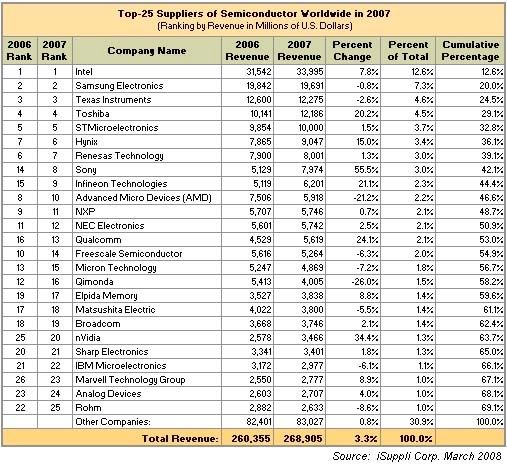
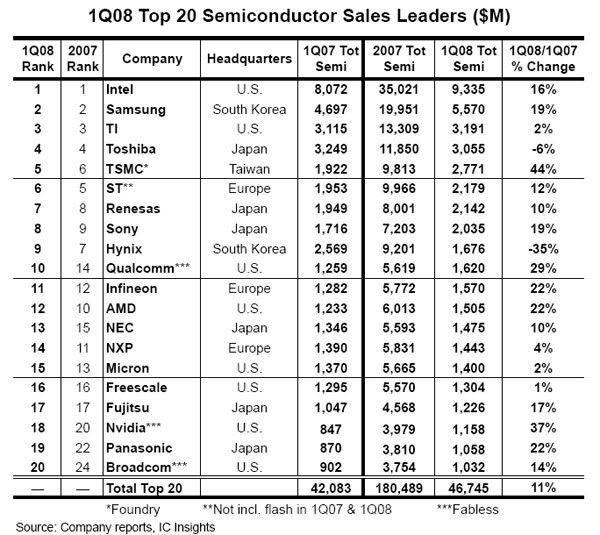
DRAM makers still going south in Q1 2008

Global semiconductor market revenue grew 3.3% in 2007, iSuppli says, lower than the firm's 4.1% estimate in November. For the quarter, semi revenues fell 0.5%, but were up 2.4% excluding memory.

Worldwide DRAM revenue fell 19.1% sequentially in the fourth quarter, below the November estimate of a 4.7% drop. NAND flash revenue declined 3.9%. Overall, memory chip revenue fell 11% sequentially. Many of the major DRAM and flash suppliers such as Qimonda, Elpida, Spansion, Powerchip and Nanya are no longer part of IC Insights' top 20 semiconductor ranking. DRAM-supplier Qimonda, whose nightmare continued in Q1 as the company dropped 10 positions from 19th overall in 2007 to 29th in Q1 based on a 52% sales decline year-over-year. Memory suppliers Hynix (9th place) and Micron (15th place) each fell two spots in the ranking although Micron reported a 2% increase in year-over-year sales while Hynix dropped 35%.

Sources:
Poor Memory Hampers 2007 Growth
iSuppli Corp, March 2008
Many major memory suppliers out of top 20 semi supplier ranking

Feb 11, 2007

The chip behind the mask

The dictionary gives the meaning of the word “mask” as a “false face used among primitive races to exercise witchcraft and sorcery.” The word “mask” also denotes a “covering worn on the face to conceal identity.” In realms far removed from masquerade balls, Infineon also uses masks – but, as one might well expect, for entirely different purposes.

The masks in our field define the structures and hence the functions of the chip. Structures signify the elementary components of a chip, i.e. transistors, diodes, resistors, capacitors and their interconnections. These elementary components, in turn, have sub-structures such as doping areas or isolation layers, which are ultimately defined by the masks.

Masks are projection patterns and are used in the photolithographic exposure units in the front-end fab. They are glass plates made of high-purity quartz glass provided with a thin layer of chrome. The light-proof chrome layer defines the structures transferred to the wafer by an exposure process. Very stringent demands on the material are made in terms of purity, transmissivity and planarity. Photo masks have to be absolutely flawless because any defect would find itself on each wafer during exposure. So it is that the mask is the blueprint with which many millions of identical chips are produced. The structures of the mask are about four to five times larger than the structure to be created on the wafer, i.e. the structures on the masks are scaled down by the factor 4 to 5 as a result of the exposure process.

A varying number of masks are required for one chip, depending on complexity. Chips for power electronics or discrete components are of low complexity and get by with some 10 to 15 masks. Memory chips and complex logic chips need about 20 to 30 masks. Highly complex logic chips with numerous metal layers and high-frequency chips in BiCMOS technology require 30 to 40 masks.

The fewer masks required for the production of a chip, the better. This is so because each mask involves numerous additional production steps, such as applying photoresist, hardening photoresist, exposing or etching off photoresist. Firstly, these all harbor some probability of failure which potentially increases the scrap rate, and secondly they prolong the time of the wafer in the front-end fab and so also the time to market. And, on top of all that, each mask also costs money. Masks are the most expensive “material” used for chip manufacture. The cost for the complete mask set of a complex chip for a 65nm process meanwhile ranges at seven-digit level.

Mask manufacture is today a science in itself. The chrome structures are vapor deposited on the glass substrate in cleanroom processes. It is not least to the credit of the masks that we can today produce chip structures far smaller than the wavelength of the laser light used. The nature of the light is exhausted by performing breathtaking physical feats. On the one hand, the undesired light diffraction phenomenon is compensated by the mask (referred to as optical proximity correction) and, on the other, a phase shift of the lightwaves during passage through the glass substrate is attained by means of areas with varied glass thicknesses (phase change masks), which is used to control light intensity on the wafer surface. These are currently hot spots in mask manufacture. The cost of research and development can hardly be borne by semiconductor manufacturers alone.

(edited from IFX magazine Jan 26, 2007)

Nov 30, 2006

Front end, Back end


In the semiconductor industry all the process steps a wafer undergoes are called the front-end process, i.e. lithography, diffusion, ion implantation and applying the wiring levels. A wafer may pass through some stations several times, covering a distance of several kilometers in its up to seven-week odyssey. In the end the individual process steps may number as many as 500, all taking place in the front-end production hall, casually referred to simply as the front-end fab.

Front-end fabs are very capital-intensive. Furthermore, automation has reached a high degree. That’s why the labor cost does not make so great an impact on the manufacturing costs and front-end fabs are often also operated in high-wage countries.

Once the wafer has left the front-end fab, it goes to an intermediate storage facility, known as the “die bank”, and from there to the back-end fab. Here the second part of the chip manufacturing process begins. In the back-end process – taking one to two weeks – the wafer is cut up into individual ICs using lasers or dicing saws with diamond blades. They’re tested, assembled, re-tested and at the end they’re packed ready for dispatch.

Compared to front-end fabs, the labor cost in back-end fabs accounts for a larger share of the manufacturing costs. The machines are not as expensive and the proportion of manual work is higher. That’s why back-end sites are mostly located in low-wage countries.

Companies who have specialized exclusively on the front-end process are called foundries. The largest are TSMC, UMC (both in Taiwan), Chartered Semiconductor (Singapore) and SMIC (China).Companies who have specialized exclusively on the back-end process are called back-end subcontractors. The largest are Amkor (USA), ASE, Siliconware Precision (both Taiwan). There the specialization has already progressed to such a stage that some do only the testing and others only the assembly and packaging.
Mastery of front-end and back-end processes alike belongs to the concept of an IDM (Integrated Device Manufacturer). Infineon is an IDM of this kind. What’s more an IDM doesn’t just manufacture its chips, it also develops and markets them itself.

(extracted from IFX Emag 29 Nov 2006, Joe corner)

Jan 13, 2006

The rationale of chip production… or the way the cookie crumbles


At first glance the baker’s trade doesn’t have much to do with manufacturing microchips. Yet a closer look at the utilization of the prime production area – here the baking tray, there the wafer – reveals quite a few areas of common ground. The semiconductor industry definitely has the edge though.

Analysis of the baking process shows a high percentage of fixed production costs. These are accounted for firstly, of course, by the bakehouse premises (we would say fab) and secondly by the mixing and kneading machines and ovens (we say equipment). The variable costs for eggs, flour and grain (in our case wafers, gases, electricity, water) are negligible. So the machinery is in place, it just needs to be used as efficiently as possible. Optimization of the saleable products per baking tray is the name of the game.

The crux of the matter is to increase the number of cookies per oven charge. To achieve this, a first step would see simply placing the cookies closer to one another, concealing virtually the entire baking tray. We try to do that, too. The individual chips are so close together as to allow only the diamond saw-blade or laser beam to pass through. This scoring line between the chips – the so called kerf – is today only about 50 micrometers wide (about the thickness of a human hair).

A second step would see increasing the number of cookies by downsizing them – at the same selling price, of course. This recommendation would work as long as the customer still recognizes the cookies as such and accepts them. Increasing the number of chips at the expense of size is common practice. It’s called “shrinking” the chips. And here semiconductor technology has a peerless advantage over all other worldly goods: the smaller chip functions just as well as its larger precursor. When it comes to the enclosed end product you can’t even tell the difference between the two versions and so they can command the same price. (At least in theory. If the customer is aware that the chip is smaller and was therefore manufactured more economically, he’ll try to beat down the price). This pattern of chip evolution, that the smaller and cheaper (i.e. the chip proper and ultimately the transistors) fill the bill just as well as - and often better than - the larger and more expensive, was once dubbed “God’s gift to man” by the scientist Yuan Taur. No other technology has undergone shrinkage on anything like this scale, and by no means over a period spanning more than four decades. Were the cookies to have been systematically downsized over this length of time, their nutritional value would meanwhile be infinitesimal.

Once the exercise of downsizing the cookies has reached the crunch point, the third stage of optimization would be introduced: larger trays and perforce larger ovens. The step to a larger wafer is witnessed about every five to seven years. A larger wafer accommodates a higher number of chips. This is so firstly because it is simply larger. Secondly, the chips can fill the peripheral area better due to the reduced curvature. The changeover to larger wafers calls for new machinery all down the line, entailing significant investment.

The final tip: twenty-four-seven baking for better utilization of the machinery and ovens. This is a step the baker reluctantly accepts. Needless to say though, production in the chip industry operates in shifts, day and night. Economic reasons dictate that the multibillion-dollar machinery must not be left idle at any time.Getting to grips with the immense fixed costs hence requires vast quantities. It is imperative to use the most precious commodity, the wafer surface, as efficiently as possible. Therefore it is not without good reason that it’s occasionally also referred to as ‘real estate’.At ground-root level many of our colleagues are doing nothing other than the baker next door: baking smaller and smaller cookies to increase the output per tray. It just remains to be hoped that they’ll also sell like hot cakes!

(copy-paste from internal IFX emag: Joe corner)